
When we move through darkness and chaos, one of the most disorienting losses is the loss of a world that once made sense. We are not only grieving what has been taken; we are grieving the collapse of the way we understand God, ourselves, and how life was supposed to work.
In these seasons, faith no longer feels like confidence, but stumbling through the darkness. However, we learn to walk in the dark, placing one foot in front of the other, without reassurance or a clear map.
Jesus called Himself the Way. And on the cross, by crying out the opening words of Psalm 22, He reveals the shape of this journey. It is not a straight line upward where everything steadily improves. Nor is it a neat circle that returns us to where we began. The journey is V-shaped: a descent into loss, bewilderment, and silence, followed by a slow and costly ascent toward restoration.
Many first-century Jews would have understood Psalms 22, 23, and 24 to function as a unified whole. By invoking Psalm 22 from the cross, Jesus was invoking the entirety of that prayer: the descent into darkness, God’s presence in the valley, and the final restoration by God.
This is the shape laid out by Jesus’ prayer while nailed to the cross. It is the shape of Job’s life as he weeps on the ash heap. And it is the trajectory of the faithful who must walk through the valley of the shadow of death.
This means that no matter how dark it becomes, we can no longer say, “No one understands what I am going through,” because Job has walked this road and Jesus has walked it too.
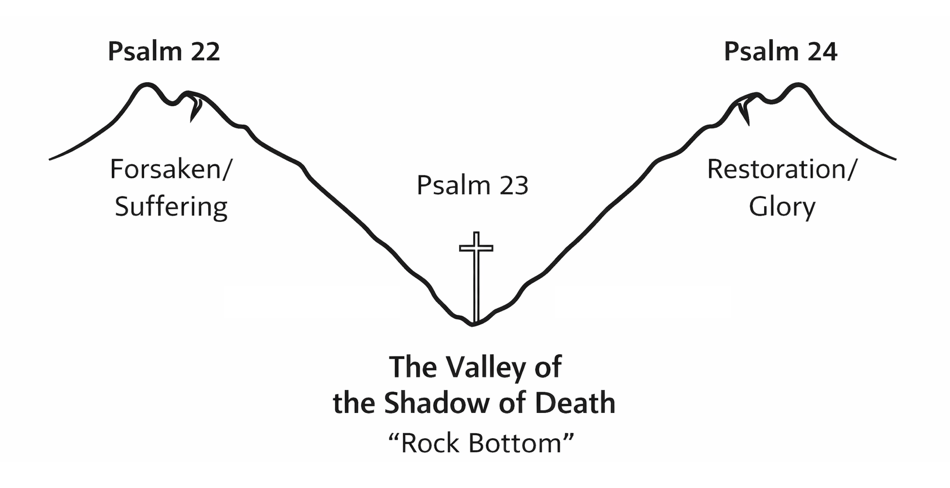
Psalm 22: Descending into the Depths
“My God, my God, why have you forsaken me?”
Psalm 22:1 & Matthew 27:46
Psalm 22 begins where many of us have stood. It gives voice to the experience of divine distance. The feeling that God has withdrawn just when He is most needed.
This is often where faith is most shaken. We continue to believe in God, but we experience Him as absent. Prayer becomes strained. Worship feels hollow. Silence stretches longer than we expected.
And yet Psalm 22 does not dissolve into despair. One of the most striking things about Job is that he never stops praying. His prayers are not polished or restrained; they are verbal confrontations and soul-wrenching laments. But beneath the anguish is a stubborn refusal to let go of God altogether. Faith here is not confident or composed. It is tenacious. It is raw. It clings to the promises God has made and protests without walking away.
Sometimes the truest act of faith is refusing to sever the relationship when nothing makes sense.
Psalm 23: The Valley That Must Be Walked
“Even though I walk through the Valley of the Shadow of Death, I will fear no evil, for you are with me.”
Psalm 23:4
While Psalm 23 opens with calm images of green pastures and still waters, it does not leave us there. This psalm is not about avoiding hardship; it is about being led through it. The valley of the shadow of death is not bypassed. It is entered. And we do not sprint through it. We walk it, because this is where faith becomes real.
Here, the distant deity we may claim to know is revealed as a personal Savior who walks beside us. God makes Himself known not as the One who removes the valley, but as Emmanuel—the God who is with us in it.
Verse 4 declares “I will fear no evil, for you are with me.”
Not fixing.
Not clarifying.
With.
Faith in the valley rarely feels triumphant. It feels like endurance. It looks like getting up again tomorrow. It sounds like breath prayers stripped of words.
The comfort of this Psalm does not come from answers, but from companionship. The shepherd does not shout directions from the mountaintop. He stays close in the darkest of valleys.
Psalm 24: The Ascent of Trust
“Lift up your heads, O gates…
that the King of glory may come in.”
Psalm 24:7
Psalm 24 lifts our eyes upward—not away from suffering, but beyond it.
This is not naïve optimism. It is the declaration that the darkness of the valley has not dethroned God. That suffering has not undone His reign. That the One who seemed silent in the depths is still the King of glory.
The ascent does not erase what came before. The wounds remain part of the story. But faith is reoriented and our perspective widens. God is no longer demanded to explain Himself. He is trusted to be Himself.
Job does not receive the answers he wanted from the whirlwind. But he does rediscover the awesome presence of God.
The V-shaped journey does not return us to innocence. It leads us into maturity. It produces a faith that has passed through trial, endured the valley, and learned to lift its eyes once again upon the author and perfecter of our faith (Hebrews 12:1–2).
- When did life stop making sense for you? What changed and how did it affect your faith?
- What stage of the journey are you in right now? Psalm 22, 23 or 24?
Order “Journey with Job: a lenten study guide”
Discover more from Wes Barry
Subscribe to get the latest posts sent to your email.
